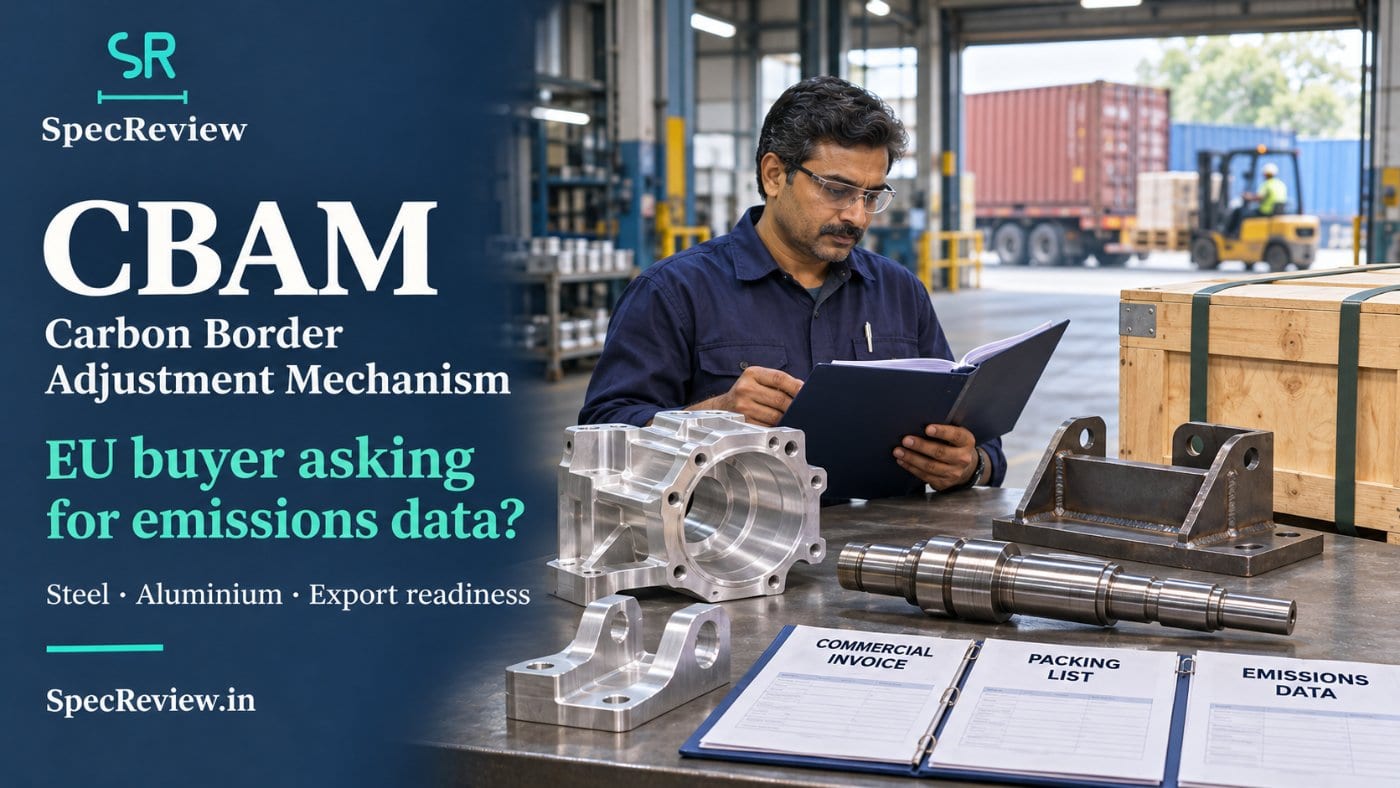
If you machine or fabricate steel or aluminium parts and ship them to Europe, you may already have received an email from your buyer asking for "embedded emissions data". That request comes from the EU's Carbon Border Adjustment Mechanism (CBAM). You do not pay CBAM yourself, but your European customer does, and they need numbers from you to do it.
This is a general guide, not tax, legal or customs advice. Check the current rules and your product's classification with your customer, customs broker or a qualified adviser.
What CBAM is
The European Commission describes CBAM as "the EU's tool to address carbon leakage by ensuring that the price of imports reflects their embedded carbon emissions." In simple terms, if a European company imports goods with carbon emitted in making them, it has to pay a carbon price similar to what a European producer pays under the EU Emissions Trading System.
CBAM covers six sectors: cement, iron and steel, aluminium, fertilisers, electricity and hydrogen. For Indian component suppliers, iron, steel and aluminium are the ones that matter.
Key dates
- 2023 to 2025: transitional phase, mainly reporting
- From 1 January 2026: the definitive regime applies
Under the definitive regime, the Commission says importers have obligations including authorisation, reporting, and the purchase and surrender of CBAM certificates that correspond to the embedded emissions of imported goods. The certificate price is linked to EU ETS allowance auction prices.
So the cost falls on the EU importer, who is the authorised CBAM declarant. But that cost is calculated from data about your product, and if verified data is missing, the importer may have to fall back on default values. That is why buyers are pushing suppliers.
Is your part covered?
Not every steel item is automatically in scope. CBAM applies to specific goods listed by customs (CN) code in Annex I of the CBAM Regulation. The Commission's quick guide for non-EU operators tells producers to compare the CN codes of their products against that list.
Practical steps:
- Confirm the HS/CN code on your commercial invoice and shipping bill for each export part
- Ask your EU buyer whether they treat that code as a CBAM good
- If your part is made from bought-in bar, sheet or castings, note that the steel itself is a precursor, and its emissions count too
Do not assume your part is out of scope just because it is "machined" or "fabricated". Check the code.
What your buyer will ask you for
According to the Commission's quick guide (dated August 2026), at some point the importer will contact you to gather information on the embedded emissions of CBAM goods. The main points:
- Producers prepare an annual operator's emissions report and a summary, using a mandatory template
- For goods imported in 2026, the reporting period is 2026
- Actual data can replace default values only if it is verified by an accredited verifier, accredited by a National Accreditation Body in the EU
- Data on precursors must include a valid, positive verification report from the installation that produced them
- Registering in the CBAM Registry is recommended but currently voluntary; otherwise data can be shared with declarants using the same report template
- Default values are described as the very last resort, for example when a precursor producer does not provide data
- A carbon price actually paid in the country of production can reduce the CBAM obligation
For a machine shop, this means two sources of data: your own process energy (power, fuel, furnace use) and your raw material supplier's emissions data for the steel or aluminium.
Why this matters for Indian exporters
GMK Center reported in February 2026 that Indian steel exports to Europe were expected to decline due to CBAM, and that the EU-India trade agreement does not provide exceptions to CBAM. For small exporters of parts, the risk is quieter but real: a buyer comparing two similar quotes may favour the supplier who can provide verified, credible emissions data, because it lowers the buyer's own CBAM cost and paperwork.
CBAM is paid by your EU customer, but it is decided by data you supply.
A practical starting checklist
- List every export part with its CN code and customer
- Ask your steel and aluminium suppliers what emissions data and verification they can provide
- Start recording electricity, fuel and furnace use by product line, not just one monthly bill
- Keep material traceability (heat numbers, mill test certificates) tied to each export lot
- Talk to your buyer early about what template and format they want
- Budget time for verification if your buyer wants actual rather than default values
Illustrative example: a fabricator shipping welded steel frames to Germany may find the frames are listed under a covered code. The buyer then asks for the steel supplier's emissions report plus the fabricator's own process energy. If neither is verified, the buyer may use default values and may reconsider pricing at the next RFQ.
How SpecReview helps
CBAM data starts with clean, consistent export paperwork and material traceability. SpecReview builds export documents such as the commercial invoice, proforma, packing list and CoC from a customer PO, which helps keep product descriptions and quantities consistent across each shipment while you collect the emissions data your buyer needs.