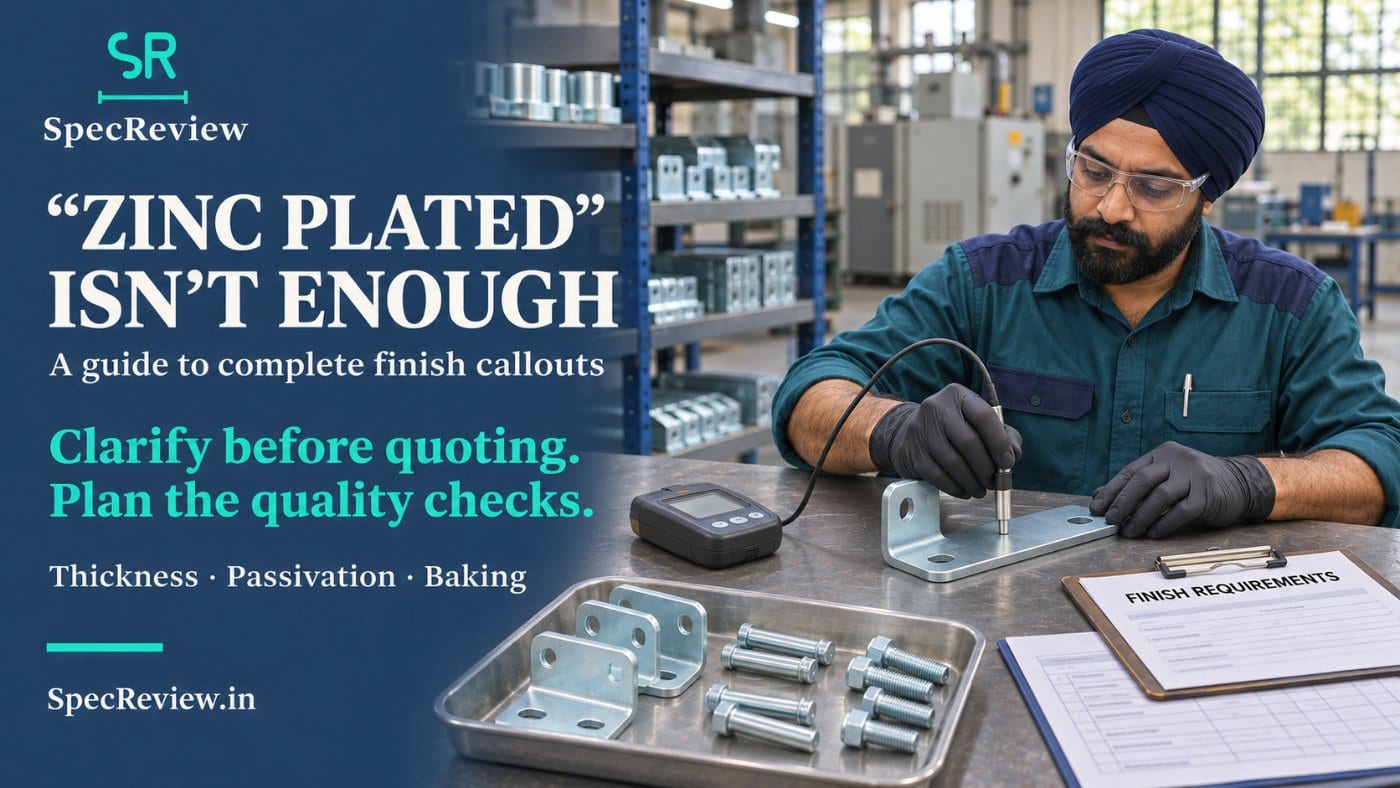
A drawing note that just says "Zinc plated" is one of the most common reasons a plater, a supplier and a customer end up arguing over a rejected lot. The plater picks a thickness, the passivation colour is whatever his line runs that week, and nobody bakes the hardened parts. A complete zinc plating callout fixes all of this in one line, and it costs nothing to write.
What a complete zinc plating callout must say
Two standards cover most zinc electroplating callouts seen in Indian machine shops: ASTM B633 (common on US-origin drawings) and ISO 2081 (common on European drawings). Whichever one your customer uses, the note should answer five questions:
- Which standard and which edition. ASTM B633 says the purchaser shall state the standard, its date of issue, the service condition number and the Type.
- Minimum thickness on significant surfaces, in µm.
- Supplementary treatment, that is, the passivate or conversion coating.
- Hydrogen embrittlement relief (baking) if the part is hard or high strength.
- Significant surfaces, if threads, bores or recesses need a minimum thickness too.
ASTM B633: service condition and thickness
ASTM B633 groups zinc thickness into four service conditions. The minimum thickness is written into the designation:
- Fe/Zn 5, SC 1 (mild): 5 µm minimum
- Fe/Zn 8, SC 2 (moderate): 8 µm minimum
- Fe/Zn 12, SC 3 (severe): 12 µm minimum
- Fe/Zn 25, SC 4 (very severe): 25 µm minimum
For threaded fasteners, the standard notes that a coating much thicker than 8 µm is usually not practical, because the thread fit suffers. So if a drawing asks for SC 3 on an M6 thread with a 6g tolerance, raise it as a query before you quote, not after the go gauge refuses to enter.
Types: the passivate decides the salt spray hours
The B633 Type says what goes on top of the zinc, and each Type carries a minimum neutral salt spray life:
- Type I: as plated, no supplementary treatment
- Type II: coloured chromate, 96 h
- Type III: colourless chromate, 12 h
- Type IV: phosphate conversion coating
- Type V: colourless passivate, 72 h
- Type VI: coloured passivate, 120 h
Types V and VI were added so that non-hexavalent-chromium passivates can replace the old chromates, and the current edition says a conversion coating on zinc shall not contain hexavalent chromium. In practice, when an auto customer asks for "trivalent blue" or "trivalent yellow", map it to Type V or VI and agree the salt spray hours in writing. The standard also says to age the passivated parts for at least 24 h at room temperature before the salt spray test, so plan this into your PPAP timeline.
Hydrogen embrittlement: when baking is mandatory
Electroplating can push hydrogen into hard steel, and the failure shows up later as a cracked bolt or a snapped circlip in the field. ASTM B633 sets clear triggers:
- Parts with tensile strength above 1200 MPa (about 39 HRC), and surface-hardened parts, shall be baked after plating. Baking must start within 4 hours of coming off the plating line.
- Steel above 1000 MPa (about 31 HRC) that carries cold-forming or straightening stresses must be stress-relieved before plating.
- Steel above 1700 MPa (about 46 HRC) should not be zinc electroplated at all.
If your part is case hardened or above 39 HRC and the drawing says only "zinc plated", ask for the baking requirement before you quote.
For example (illustrative), an EN 19 pin hardened to 40-45 HRC and zinc plated needs a baking step and a bake record from the plater. That is an extra process, extra lead time and an extra line on your control plan, so it belongs in your price.
ISO 2081 callouts and the edition trap
ISO 2081:2018 covers electroplated zinc with supplementary treatments on iron or steel. Its foreword notes that the coating and supplementary treatment designations were changed from the 2008 edition, that the salt spray reference moved to ISO 9227, and that hydrogen embrittlement treatments refer to ISO 9587 (before plating) and ISO 9588 (after plating). The 2018 edition is now listed as withdrawn and revised by a 2025 edition.
The practical lesson: a designation copied from an old drawing may not mean the same thing in the current edition. If the drawing quotes ISO 2081 without a year, confirm which edition the customer audits against.
Thickness, threads and significant surfaces
ASTM B633 says minimum thickness applies to significant surfaces designated on the drawing or shown on a marked sample. Threads, holes, deep recesses and inside corners are normally exempt unless the drawing says otherwise. Also note:
- Thickness is measured after the passivate is applied for Types II to VI.
- Some magnetic and coulometric methods may not be accurate on coatings from non-cyanide zinc baths, so agree the method with your plater and customer.
- Mask or plug tapped holes, or machine threads with plating allowance, if the thread gauge must pass after plating.
How SpecReview helps
When you upload the drawing PDF, SpecReview flags an incomplete finish note such as "zinc plated" with no thickness, Type or baking requirement as a spec gap to clarify before quoting. The quality plan then carries the coating checks, so thickness, salt spray and bake records are not forgotten at PPAP time.